
The Moral Landscape
Animals, reciprocity, and ecological limits in Mesoamerican worlds

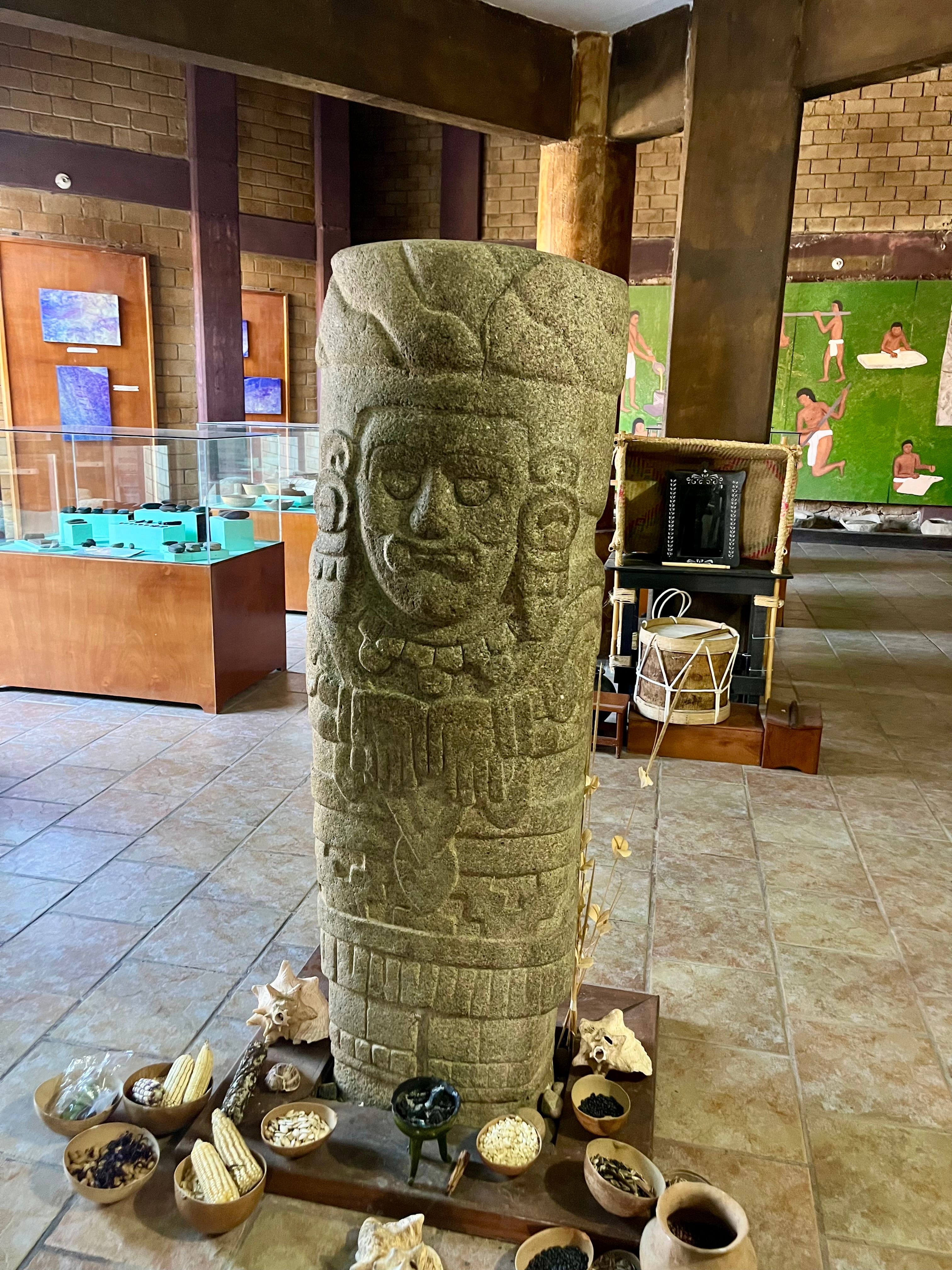
There are moments when seeing something causes insights to jell. I had such a moment on a recent visit to Tututepec, once the capital of a Mixtec kingdom on the Oaxacan coast. What caught my attention was a Mixtec stela in a museum there that, despite centuries of Catholic Church suppression, continues to be part of Mixtec ritual life. Offerings are still left regularly around it.
As I pondered what kind of worldview makes such continuity not anomalous but necessary, it became clear that this stela cannot be understood as an idol emptied of agency by conversion, nor merely as a museum artifact. Its continued veneration instead reveals a cosmological view in which there is no separate realm called “nature.” Rather, the stela is embedded in a sacred landscape in which humans, mountains, hills, stones, rivers, and ancestors exist in a single field of action.
What struck me is that many of the most misunderstood dimensions of Mesoamerican culture—sacred landscape, ritual obligation, tonal and nagual beliefs, saints’ cargos, calendrical cycles—are not just “belief systems” in the way they have long been framed. They also pattern and organize ecological relations with land, water, animals, and one another with a sophistication that modern conservation often struggles to match.
Rain, fertility, health, and political harmony are not givens. They are outcomes of ongoing negotiation and ritual reciprocity with the beings who animate the landscape—mountains, springs, clouds, saints, and ancestors.
Within this sacred landscape, wild animals are commonly understood to belong to an Earth Lord, often likened to a hacendado with a great ranch inside a mountain. He protects game but will grant access to his animals if ritual payment is offered for those taken. If offerings are not made, or if hunting becomes commercialized, he may withhold game or, in more serious cases, withdraw protection from a person’s tona. Through this ownership, relations with animals are structured not by open access but by obligation, restraint, and the ever-present possibility of withdrawal.
In this worldview, humans and animals are bound intimately together in ways that differ sharply from Western cultures. Each person has a tona—an animal counterpart—whose fate is so closely joined to their own that what happens to one happens to the other. This world also includes naguals, powerful animals that curanderos and witches can become through ritual practices, sometimes involving sacred mushrooms. This transformation is understood as real, not symbolic, and allows movement between different states of reality and other-than-human worlds.
What often gets missed in analyses of tonal and nagual beliefs—many of which focus largely on symbolism—are the ecological dimensions of these beliefs and practices. These systems endure not simply because they express ideas about nature, but because they entail practices that bind human fate to animal life.
In the mid-1980s, with the help of my father-in-law, a Chatino speaker, we drew up a list of animals found in the region and interviewed Chatino from various towns. The exercise was deliberately simple. For each animal we asked three questions: whether it was killed, whether it was eaten, and whether it was associated with nagual or tona relations. There was considerable agreement across communities about pests and about the kinds of animals associated with nagual danger. When it came to tonas, however, there were differences from one town to another. These differences were not open-ended. A core group of tona animals kept reappearing, and it is on this core that I will focus here.
The exercise also revealed two additional groups that occupy very different positions in local thinking: non-tona animals that are killed and eaten, and pests that are killed but not eaten.
By far the largest category consists of non-tona animals that are hunted, killed, and eaten. These animals form the backbone of everyday subsistence and occupy a distinct position in the cosmological landscape. While their hunting is not governed by personalized moral relationships between hunter and prey, it is not morally neutral. These animals are understood to belong to the Earth Lord, and general prohibitions against waste and against selling wild meat remain in force. When these limits are violated, misfortune is understood to arise not through direct retaliation, but through the withdrawal or withholding of animals by the Earth Lord—expressed as bad luck in hunting or the disappearance of game from the landscape.
Pests occupy a distinct position in the cosmological landscape. Unlike game animals, they are not eaten, and unlike tonas or naguals, they are not bound to humans through relationships of moral identification or warning. They are understood to fall outside the protective domain of the Earth Lord and to participate in no reciprocal exchange with humans or the landscape. Their multiplication is seen not as a gift, but as a threat that consumes crops and food stores without any reciprocal return.
Killing them is not a transgression that invites retaliation. Instead, it is seen as a necessary act in a landscape whose balance depends on reciprocities among humans, animals, and the gods. In this sense, nagual animals—often predators—appear as counterweights to pests, restraining the unchecked multiplication of beings that fall outside reciprocal relations.
Taken together, these two categories establish the moral baseline against which tonal and nagual relations stand out. Most animals are either legitimate food, subject to conditional access and restraint, or pests eliminated without moral concern. Tonas and naguals do something different. They introduce moral risk where killing would otherwise be permitted, transforming encounters with particular animals into moments that demand interpretation rather than action.
Among the animals that are not killed are those associated with naguals. These tend to be predators, nocturnal, or otherwise liminal creatures—animals that live at the edges of visibility and control. Jaguars, pumas, coyotes, foxes, owls, snakes, and birds of prey recur with striking consistency, and not by accident. In cultural terms, they mark power, danger, and responsibility. They are not spared out of reverence, but because killing them is understood as an act of provocation—one that would invite retaliation extending beyond the animal itself. Their movements and appearances are read as warnings: signs of illness, impending danger, or emerging social strain.
Among the clearest cases are owls. Across Mixtec, Chatino, Nahua, Zapotec, and Highland Maya accounts, owls are widely treated as omens of death. Their cries are read not as predictions but as temporal markers of processes already underway: illness, an approaching death, or a looming conflict. Jaguars and pumas are similarly interpreted as signals of major rupture—political conflict, sorcery, or the impending death of an important person. Coyotes, foxes, and snakes encountered at unexpected times or in anomalous places function as classic warnings. Such encounters prompt immediate responses—offerings, counter-rituals, or withdrawal—aimed not at veneration, but at containment.
Common sense tells us that owls calling at night or coyotes crying in the distance are ordinary features of many landscapes. What matters is when they are noticed. A sound that passes without comment on one night becomes charged on another—when someone is ill, conflict is brewing, crops are failing, or a moral or ritual boundary has been crossed. In such moments, the encounter sharpens attention and raises the stakes, compelling people to read what is already happening more carefully and to act as if consequences are immediate.
Predators and other liminal species often respond early to shifts in prey populations, disease, human disturbance, or altered movement corridors, sometimes before those changes become legible to people. When their presence or behavior suddenly stands out, it draws attention to disturbances already underway, sharpening collective awareness at moments when imbalance is beginning to spread.
Tonas present a puzzle. On the one hand, the fate of a person and their tona animal are understood to be intimately intertwined. On the other, tonas are commonly associated with crop-raiding species—deer, peccary, coati, birds, and rabbits—that are routinely killed and eaten to protect fields. This apparent contradiction is partly resolved by the fact that people refrain from hunting their own tona animals and those of close family members.
When animals identified as tonas are examined ecologically, the central questions concern vulnerability: which species are most exposed to human pressure, and whether tona beliefs play any role in moderating that pressure. In any ecosystem, vulnerability turns on two factors: the number of hunters and the reproductive rate of the species involved. Simply put, deer are far more vulnerable than rabbits.
The ethnographic question, then, is how many hunters are likely to have a vulnerable species as a tona. That, in turn, depends on how tonas are assigned and how their human counterparts are determined. Two systems are found: one based on calendrical assignment, the other on divination by ritual specialists.
In the prehispanic system, a 260-day ritual calendar with twenty named days fixed a person’s tona by their day of birth. Among the Mixe of Tamazulapan, where I worked in the early 1990s, this system was still in use. There, roughly five percent of those born shared the same sign.
Suppose that each person with a deer as a tona has six to eight close relatives who have qualms about hunting deer; this could reduce local hunting pressure by 30 to 40 percent. The elegance of this system is that it does not require a community-wide taboo, only localized, kin-based restraint structured through calendrical assignment.
Following the conquest, the Catholic Church tried to root out Indigenous ritual practices. Few communities retained calendrical systems, and tona assignment often shifted to divinatory procedures. Commonly, ritual offerings are burned and the ashes spread in a circle around the house; the following day, a curandero interprets which animal has left its tracks.
Although the means of assignment changed, the range of animals recognized as tonas remained bounded, drawing from a familiar set of locally salient species rather than expanding indefinitely. Over time, these inventories show greater variation, at times incorporating domesticated animals; nevertheless, core species continue to recur.
Modern ethnographic accounts indicate that communities typically recognize between ten and twenty-five tona animals. While the specific composition of these sets varies considerably from place to place, they consistently include species especially vulnerable to human pressure, such as deer. Despite differences from the calendrical method, the proportion of hunters who would have qualms about killing a given species is likely to have remained broadly similar.
The fiesta system may also play a role in moderating pressure on vulnerable species. Fiestas tend to cluster during periods when household corn stocks are lowest and typically involve communal feasting. These events not only feed the community collectively but often allow households to take food home as well. In rural settings, it is often the most food-insecure households that place the greatest pressure on local natural resources. To the extent that communal feasting temporarily reduces subsistence stress, it may soften hunting intensity during these periods. Because slow-reproducing, high-value game such as deer are most vulnerable during times of scarcity, even short-term reductions in hunting pressure during the lean season could have significant effects on local populations.
Some final contemplations
What struck me about the stela surrounded by ritual offerings was how completely the museum misread it. By treating the stela as an artifact and the offerings as survivals of belief, it confines their meaning to a pre-Hispanic past and denies their relevance in the present. In doing so, the museum drains these practices of their living force. They have endured not because they are customs, but because they continue to mediate human relations with the natural world in ways that still make sense.
Humans never encounter nature directly. Nature is always perceived through systems of meaning that tell people who they are, what they owe, and what follows when those obligations are ignored.
Sacred kinship with animals required no external rules to restrain exploitation. Compared to this, modern conceptions of nature as something separate from ourselves—as a stock of resources available for use without reciprocal obligation—appear morally and ethically thin.
These practices are not some romantic vision of harmony. They are a way of inhabiting a landscape that recognizes humans are never autonomous and never exempt from consequence. Mountains, animals, rain, illness, fertility, and luck are not separate domains, but part of a single field of relations that must be continually tended.
In this world, the sacred is not confined to churches or saints’ images. It is the language through which people make sense of uncertainty, scarcity, and risk. These beliefs have material consequences. Tonas bind human fate to animal life. Naguals mark moments when balance is already slipping. The Earth Lord frames hunting as negotiation rather than entitlement, bounded by obligation and restraint. Fiestas redistribute food precisely when hunger would otherwise drive harder extraction from the landscape.
Seen from this perspective, the Mixtec stela at Tututepec is neither an anachronism nor a relic that somehow escaped modernity. It is a working element within a living system that refuses a sharp divide between humans and nature, belief and practice, the sacred and the practical. It is evidence that this way of understanding the world still works.
Modern environmental governance depends heavily on law and often pits industrial interests against those of environmentalists. Enforcement is therefore central—and notoriously difficult. By contrast, Mesoamerican sacred beliefs generated obligations that felt legitimate because they were internalized rather than imposed.
What the stela at Tututepec makes visible is not a lost past, but a missing dimension of the present—one in which governance begins not with control, but with obligation.
Suggested Readings
Greenberg, James B. Santiago’s Sword: Chatino Peasant Religion and Economics. Berkeley and Los Angeles: University of California Press, 1981.
Jansen, Maarten, and Gabina Aurora Pérez Jiménez. Encounter with the Plumed Serpent: Drama and Power in the Heart of Mesoamerica. Boulder: University Press of Colorado, 2007.
Monaghan, John. The People of the Middle Place: Political Economy and Cosmology in the Mixteca Alta. Berkeley: University of California Press, 1995.
Wow, what a fascinating assessment!
James, I appreciated how this piece centers relationship and obligation as the basis for how humans live within ecological limits. The way you describe encounters with animals or landscape as moments that call for care, restraint, and interpretation reflects a worldview where humans are participants in a shared moral field, not separate managers of it.
What resonated for me is how accountability arises from felt connection rather than external control. When responsibility is internalized through relationship—with land, animals, and community—it naturally tempers extraction and excess. This offers a compelling contrast to systems that rely on regulation without cultivating ethical connection.
Your reflection points toward a way of organizing human life that prioritizes balance, reciprocity, and collective well-being, and it feels quietly instructive for how we might reimagine our economic and environmental choices moving forward.