
Authoritarian Drift and the Normalization of Extremism
How silence, loyalty, and spectacle move the boundaries of the possible until extremism becomes ordinary

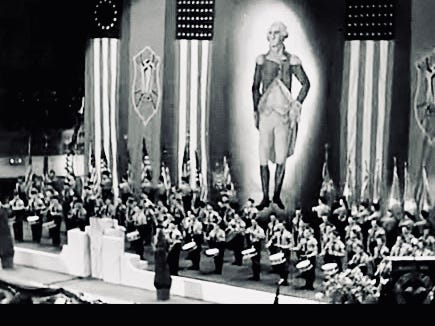
I didn’t think this administration could surprise me anymore. I was wrong. Lawrence O’Donnell’s October 14, 2025 report on The Last Word about Michael Bartels—still employed despite joining an “I love Hitler” group chat—stopped me cold. The revelation wasn’t shocking because it was rare, but because it confirmed a pattern: Trump’s inner circle is filled with sympathies once thought disqualifying. What’s striking is less one staffer’s behavior than an institution that shrugs at it. That shrug is how authoritarianism takes root.
Authoritarian systems rarely arrive all at once. They creep in as boundaries shift. What once disqualified someone from power is excused or ignored. When leaders retain staff who admire Nazi ideology while invoking antisemitism to silence campus protesters, we are not witnessing contradictions—we are seeing a strategy that normalizes some extremes while punishing others.
What sustains that strategy is not only loud voices but quiet ones. Silence functions as assent. Bureaucrats who stay in place, colleagues who avert their eyes, citizens who persuade themselves “this is not my fight”—all become part of the architecture. Authoritarian drift depends on complicity more than fanaticism.
Trump’s second term shows how drift takes form in institutions. Mass firings of civil servants, loyalty tests in the military, and appointments of figures steeped in white nationalist rhetoric are not random acts. Personnel signals what kind of politics is acceptable, and what kinds are rewarded.
Institutions, like ecosystems, rely on variety to remain strong. When diversity of thought or practice is stripped away and replaced with tests of loyalty, the system narrows into a brittle monoculture. Drift is not just about who sits in office today; it erodes the resilience of governance itself.
The evidence is not subtle. One Trump official was described by federal prosecutors as a Nazi sympathizer. Another denied the Holocaust. A third advocated for Nick Fuentes and appeared at his rally. These are not youthful indiscretions; they mark out comfort zones. Their survival inside government signals that such affinities are now tolerable at the top.
The system holds together through an economy of fear and loyalty. To be branded an “enemy within” is to risk exclusion. To show allegiance—even to extreme ideas—is to gain protection. These are not lapses in vetting. They are exchanges in a political marketplace where devotion is the only coin that counts.
Meanwhile, Trump condemns antisemitism in broad strokes while cutting funding to universities and deporting student protesters in its name. Staff with antisemitic ties remain untouched. The lesson is clear: moral language is not about principle; it is about leverage: who it can be used against, and who it can shield.
There are echoes of history. There are parallels with the early Nazi period: centralization of power, humiliation of rivals, purges of civil servants, and the cultivation of symbolic politics that plays with fascist aesthetics. These parallels do not prove ideology; they reveal drift, a climate where extremism is less an aberration than a tolerated currency.
Trump’s rallies deepen this climate. Their staging, chants like “One people, one flag, one leader,” and militaristic imagery are not entertainment but ritual—rehearsals of loyalty and exclusion. The spectacle itself becomes a form of evidence: proof of strength, proof of belonging.
What matters is not whether Trump is a fascist in doctrine. He is not Mussolini with a theory of the state, nor Hitler with a racial program. He is opportunistic. But style itself is powerful. Words like “vermin” do not simply insult; they sort people into categories that can be cast out or punished. Language is not a symptom—it is already an instrument.
Lines shift quietly. What was unsayable becomes said, what was impermissible becomes tolerated, and what is tolerated becomes routine. When someone can celebrate Hitler and remain in government, the line has already moved.
Toleration of extremism emboldens those at the margins, expanding the pool of loyalists. The more such figures are embedded, the more they reproduce the culture that welcomed them. Drift turns into normalization—a cycle of selection and reward that feeds on itself.
The deeper danger is not in a leader’s ideology but in the permissions he creates. He does not need to believe in every extreme idea—only to find them useful. What is tolerated at the top soon becomes acceptable below. The message sent to society is unmistakable: these views no longer bar you from power.
Democracy’s guardrails are not only in courts or elections but in the everyday boundaries of what we refuse to accept. Once those boundaries weaken, recovery is far harder than many imagine. Drift advances in the silence of colleagues, the indulgence of institutions, and the rituals that dress cruelty as loyalty. Until, finally, what once seemed impossible feels ordinary.
Suggested Readings
Arendt, Hannah. The Origins of Totalitarianism. New York: Harcourt, 1951.
Ben-Ghiat, Ruth. Strongmen: Mussolini to the Present. New York: W.W. Norton & Company, 2020.
Fromm, Erich. Escape from Freedom. New York: Farrar & Rinehart, 1941.
Klemperer, Victor. The Language of the Third Reich: LTI – Lingua Tertii Imperii. Translated by Martin Brady. London: Continuum, 2006.
Paxton, Robert O. The Anatomy of Fascism. New York: Alfred A. Knopf, 2004.
Snyder, Timothy. On Tyranny: Twenty Lessons from the Twentieth Century. New York: Tim Duggan Books, 2017.
Stanley, Jason. How Fascism Works: The Politics of Us and Them. New York: Random House, 2018.
Wolf, Eric R. Envisioning Power: Ideologies of Dominance and Crisis. Berkeley: University of California Press, 1999.
One remedy is a moral outrage meme that reaches breakthrough pitch, like in the Congressional hearing that toppled Joe McCarthy in the 1950's Red Scare ("Have you no shame . . . ?"). AOC's rhetoric is a good example of moral outrage, but her signal is drowned in the noise of many voices.
Another remedy is the slow and steady resistance of the three branches of government, plus media and people power. The challenge is velocity. Can outrage and resistance keep pace with the drift, propelled by its power levers flooding the zone?
It may come down to pocketbook issues. When the regime's policies ultimately fail, survival themes will float to the top.
Clear and concise warnings...Thank you again James B. Greenberg. Put this on a billboard!