

The boarding process as a ritual of sorting and an entry point into thinking about class and status
James B. Greenberg
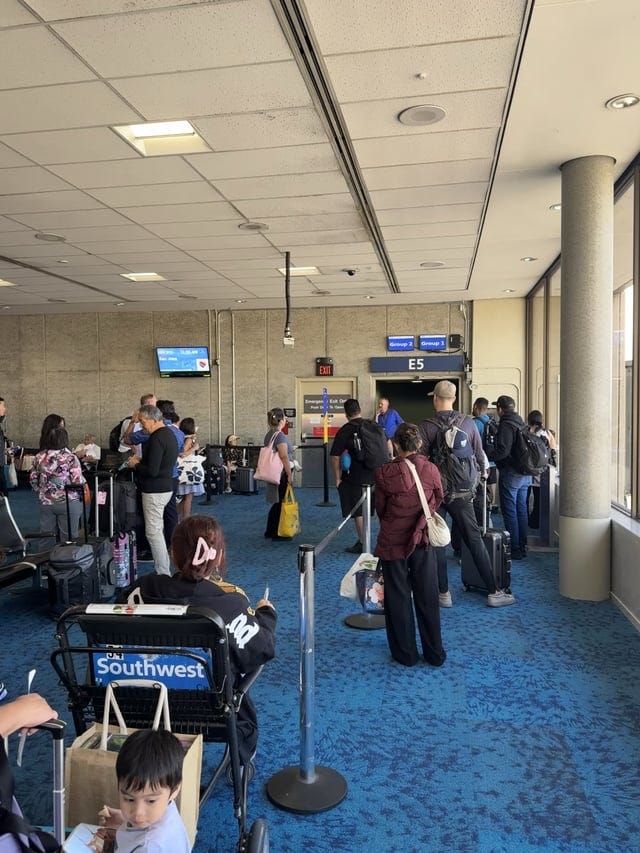
The process of boarding a flight shouldn’t stir echoes of the holocaust, but the involvement of ICE in processing people at least for me did. As I waited to board, watching the ritual sorting of passengers into groups—first and business classes, premium economy, and lastly people like myself flying economy—I began thinking about class and status. Orderings like this are always about more than the line; they are performances of social hierarchy.
What struck me first was the underlying business model. Airlines are not just selling comfort, but monetizing status, recognition, and precedence. They understand that people will pay exorbitant amounts for relatively small differences—a more comfortable seat, faster boarding, quicker exit. These are not simply perks; they are statements about status. The names are symbolic: first class, business class, premium economy, economy. What is being purchased is not just comfort, but precedence—being called first, being seen, being allowed to move ahead of others.
Marketing to status and class aspirations is such a staple of modern advertising that we rarely pause to consider its underlying message: that wealth buys privilege, and that those who cannot afford it are, implicitly, less deserving. This normalization of wealth as worth now permeates consumer culture.
We see this same model replicated in healthcare and insurance, where access is increasingly stratified. With the ascendancy of right‑wing ideas about free markets, Republicans have pursued the privatization of public goods on the theory that free markets are the most efficient way to allocate scarce resources. While this may sound good, the key to market efficiency is competition. Without regulation, unbridled competition eliminates weaker firms, turning markets into engines of wealth concentration rather than broad‑based prosperity.
The danger becomes clearer when business models are applied to government agencies. Programs and services are evaluated not on the basis of need, but on profitability, with a moral calculus of who is deemed deserving. Ledger books have no family, no social conscience, no environmental concerns, nor do they care about who suffers. Under this bottom‑line logic, unless agencies can be made self‑supporting, social services are poor investments.
The shift has been more than economic; it has redefined public life. Goods once treated as collective obligations—education, healthcare, housing—have become commodities, like airline ticket classes, available to those who can afford them. Citizenship itself has been quietly reframed as consumer capacity, empowering those with purchasing power while marginalizing those without. Risk and responsibility are pushed downward onto individuals and families, recasting structural conditions as personal failings. The result is not simply a more efficient system, but a different social order—one in which inequality is normalized and the protections once associated with citizenship steadily erode.
What I sensed as I watched the boarding process is that what appears to be a set of small, everyday distinctions signals a deeper shift in American culture. A longer view helps make sense of it. When Alexis de Tocqueville visited America in the early 1830s, what struck him was the relative absence of rigid social ranks. Unlike Europe, with its aristocracies, where birth and class structured every interaction, American society rested on a pervasive cultural assumption that no one should openly place themselves above others. Status had to be earned, and even then it had to be performed with restraint. That ethos, however, only functions when mobility feels attainable.
Those prospects have steadily narrowed over the last few decades. Globalization shifted industrial jobs overseas. National chains displaced local businesses. Wages have stagnated. Many households are a paycheck away from homelessness. Add to this the bite of inflation, and the prospects for mobility look dim.
We see instead the wealthy becoming wealthier, the middle class shrinking, and workers struggling to make ends meet. Over the past fifteen years, the top one percent has come to hold wealth roughly equivalent to that of the bottom ninety percent, while the number of billionaires has grown from about 400 to nearly 1,200. This rising inequality represents a fundamental restructuring of the American class hierarchy.
As the gap between those who can afford privilege and those who cannot widens, the American dream looks less attainable. The distance between what the market offers and what most people can afford is no longer an abstraction; it shapes the painful compromises people are forced to make daily.
The cultural shift has been just as profound. Where status once had to be earned, increasingly it is something that can be purchased and displayed. The market does not simply distribute goods; it organizes recognition. Priority boarding, premium tiers, exclusive access—these are not just conveniences, but signals. They mark who moves first, who waits, who matters. What was once a culture wary of overt hierarchy has grown more comfortable advertising it. The old expectation of modesty has given way to a sense of entitlement: if you can pay, you deserve more.
This shift alters not only how status is acquired, but how it is felt. Aspiration has not disappeared, but when the markers of success are everywhere and increasingly out of reach, they cease to inspire and begin to humiliate.
As such performances of class have become more public, the status anxiety they provoke is sharper and harder to escape. It is encountered daily, in small transactions and passing moments. It shows up in the line you stand in, the seat you occupy, the options you do not have. Over time, this produces not only a heightened sensitivity to where one stands, but a growing resentment toward those who appear to move more easily through the system.
While rising resentment and frustration often fuel authoritarian movements, its rise in America is rooted in a deeper tension between two opposing logics: the Constitution, designed to prevent the concentration of power, and a market system that increasingly concentrates wealth and influence.
The Constitution functions as an anti‑concentration machine. Its checks and balances, federalism, and institutional independence are designed to disperse authority and slow its exercise. Our contemporary market economy does the opposite. It concentrates wealth and power, producing a more hierarchical social order. Seen from its bottom‑line perspective, the Constitution’s system of checks and balances looks more like obstacles than safeguards. Authoritarianism, in this context, may be seen as an effort to align political power with economic concentration by removing those constraints.
While this project clearly serves the interests of elites, it also draws support from those experiencing the consequences of this economic system. As mobility narrows and inequality widens, status becomes more fragile. Authoritarian politics offers a substitute—not expanded opportunity, but restored standing, rooted in identity and belonging.
What I witnessed at the airport reflects this shift. A system of tiers and priority access does more than allocate comfort—it normalizes hierarchy, sorting people into ranks and rendering those who cannot afford these services increasingly invisible.
Such systems, by shifting responsibility onto individuals, normalize inequality. If you cannot afford a service, the answer is simple: you go without. At its harshest, when governments begin to decide who is entitled to protection and who is not, this logic hardens into one of abandonment. What follows is a form of necropolitics—the slow violence of exposure, in which those who cannot secure shelter, food, or healthcare are left to fend for themselves. It is that echo I sensed at the airport.
Closing Reflection
Culture shock is the disorientation people feel when they encounter a way of life very different from their own. As an anthropologist, it is something I have experienced many times. What unsettles me now is that I am beginning to feel it at home. The America I move through today often feels alien to the one I thought I knew.
I no longer see mundane rituals like the orderly boarding of a plane in the same way. I see in these small, everyday performances reflections of a larger social order organized around sorting: who moves first, who waits, who is visible, and who is not.
At the center of this shift is the commodification of status. What once had to be earned is now purchased. As access and recognition become matters of ability to pay, social burdens are quietly shifted onto individuals. Those who fall behind are seen not as constrained, but as having failed. The result is a pervasive, if often unspoken, alienation—one that erodes shared bonds and leaves people to navigate inequality on their own.
I sense a broader change as well: a movement from generosity to meanness, from the assumption that we are a wealthy society capable of meeting collective needs to a more anxious vision in which resources are scarce and others are seen as competitors for what little there is.
Most troubling is the way this environment feeds a politics of grievance. Anger and frustration are redirected toward scapegoats rather than toward the structures that concentrate wealth and power. Identity and culture become tools of division rather than sources of connection. In that context, authoritarianism finds its opening—not as a rupture, but as an extension of patterns already in place.
What I sensed at the airport was not simply hierarchy, but the normalization of a way of seeing—one that makes sorting, exclusion, and ultimately abandonment easier to accept.
Suggested Readings
Bourdieu, Pierre. Distinction: A Social Critique of the Judgement of Taste. Cambridge, MA: Harvard University Press, 1984.
Brown, Wendy. Undoing the Demos: Neoliberalism’s Stealth Revolution. New York: Zone Books, 2015.
Douglas, Mary. Purity and Danger: An Analysis of Concepts of Pollution and Taboo. London: Routledge, 1966.
Goffman, Erving. The Presentation of Self in Everyday Life. New York: Anchor Books, 1959.
Harvey, David. A Brief History of Neoliberalism. Oxford: Oxford University Press, 2005.
Mbembe, Achille. Necropolitics. Durham, NC: Duke University Press, 2019.
Piketty, Thomas. Capital in the Twenty‑First Century. Cambridge, MA: Belknap Press of Harvard University Press, 2014.
Sandel, Michael J. What Money Can’t Buy: The Moral Limits of Markets. New York: Farrar, Straus and Giroux, 2012.
Sennett, Richard. The Culture of the New Capitalism. New Haven, CT: Yale University Press, 2006.
This was a very well written observation! Thanks!
this was a wonderful article about something I experenced for 35 years -- mostly in the front of the plane and now as a retiree in the back. I would suggest to you that some of us were "earning" the seats in that we stayed loyal to one airline and our business required the travel so we could find our way to first class eventually. Didnt feel quite as elitist but still did -al little. I think you should capture that the people in the front ARE elitist and begin to act that way so much that they should be despised for their arrogance. CLEAR is one of those systems that encourages people with money to try to be more important than anyone else. Having had a verbal altercation with a man who would not move forward in the TSA line (he was a CLEAR customer), I was reminded that they don't see anyone but themselves and are petulant and arrogant. Remind you of anyone???